
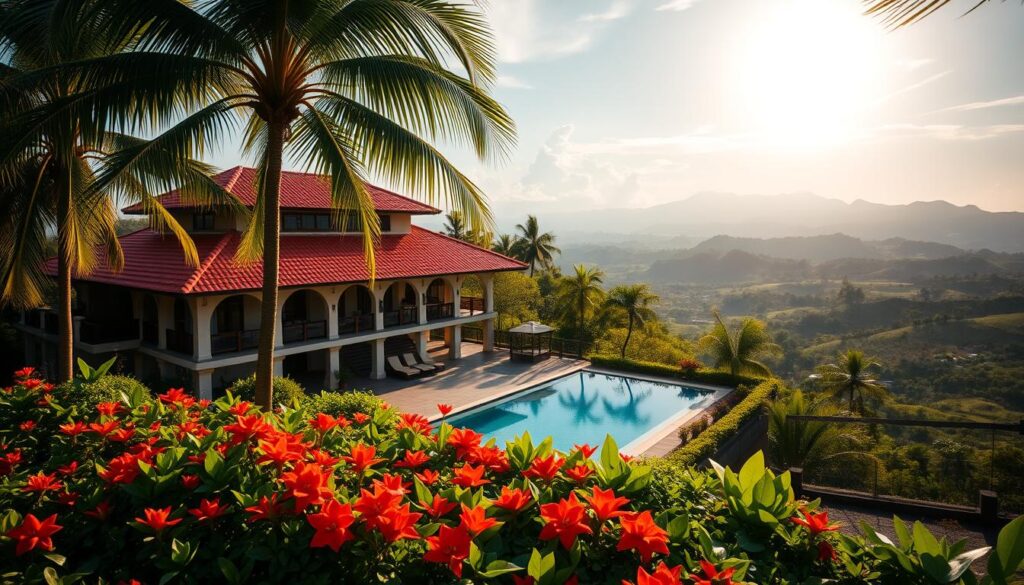
Surprising stat: international arrivals topped 5.2 million in 2023 and Bank Indonesia reported 1.92% YoY growth for off-plan prices in Q2 2023. That rebound has real impact on the island property scene.
The recovery has pushed demand and created wide price dispersion across neighborhoods. Seminyak, Canggu, Ubud and the Bukit each show very different asking figures. Buyers face headline listing numbers plus taxes, legal fees, permits and fit-out costs that often exceed the sticker price.
Key factors include tourism-driven occupancy, digital-nomad demand and interest from overseas investors. Ownership rules such as leasehold or foreign-friendly structures also shape cost and risk.
This guide previews a 2025 pricing snapshot, area-by-area comparisons, ownership and permit basics, the true acquisition cost, yield expectations, and practical buying steps. Read on for clear details that help match budget with the right area and strategy.
Key Takeaways
- Tourism recovery and arrivals are lifting villa demand and prices.
- Sticker price is only part of total acquisition costs.
- Area choice drives major variation in asking prices and returns.
- Legal ownership forms affect cost, control, and risk.
- Due diligence, title checks, and negotiations are essential for value.
2025 Snapshot: Villa Prices, Market Pulse, and What Drives Costs on the Island
Visitor volumes and steady macro signals are supporting steady price momentum across Bali this year. Bank Indonesia’s RPPI showed 1.92% YoY growth for off-plan homes in Q2 2023, a sign investors watch closely.
Tourism recovery matters: more than 5.2 million international arrivals in 2023 (up 24.5%) has lifted accommodation demand and rental income potential for owners.
Prime pockets—Seminyak, Uluwatu and Canggu—report luxury price gains near 10% annually. That reflects scarce beachfront land, strong buyer interest, and higher per-unit returns.
Infrastructure upgrades, like improved highway links, are expanding viable residential corridors. Shorter travel times raise perceived value and broaden buyer interest beyond traditional hotspots.
Seasonality and occupancy cycles still shape rental yields. Investors track RPPI, annual arrivals, and construction pipelines to judge near-term direction and risk.
- Steady growth: prices buoyed by tourism rebound and resilient buyer demand.
- Submarket split: luxury-tier properties outperform due to scarcity and global appeal.
- Infrastructure: new access compresses distances and lifts area premiums.
- Affordability note: relative value versus other resort markets, with variance by submarket.
| Indicator | Recent Data | Impact on Prices | Investor Takeaway |
|---|---|---|---|
| RPPI (off-plan) | 1.92% YoY (Q2 2023) | Signals steady price momentum | Watch for local adjustments vs. headline gains |
| International arrivals | 5.2M in 2023 (+24.5%) | Boosts rental demand and seasonal yields | Favors short-stay and managed properties |
| Luxury zones | Up to ~10% annual growth | Higher premiums for beachfront/amenity locations | Scarcity drives price resilience |
| Infrastructure | Highway and access upgrades | Expands viable development corridors | Creates new value pockets outside core towns |
Villa Price Guide by Area: Seminyak, Canggu, Ubud, Uluwatu, Sanur and Beyond
D) From clifftop mansions to rice-field retreats, each area posts its own realistic price bands for two- and three-bedroom stock.
Quick comparatives below show typical 2025 estimates so buyers can scan value by location and product type.
- Seminyak — Three-bedroom mansions around $500,000; luxury beachfront villas range from $900,000 to $3,000,000. Proximity to beaches and nightlife drives premiums.
- Canggu — Two-bedroom entries start near $248,000; three-bed homes with private pool climb toward $840,000 in prime surf and cafe zones.
- Ubud — Three-bedroom villas average near $250,000, often with rice views and wellness-focused design that appeals to long-stay guests.
- Uluwatu / Bukit — Cliff and ocean-view villas typically sit between $277,000 and $770,000+, with elevation and design adding price uplift.
- Sanur & Nusa Dua — Family-friendly properties generally trade from about $150,000 to $400,000 in well-established neighborhoods.
- Emerging areas — Tabanan, Pererenan, Seseh and parts of North Bali offer lower land and build costs and upside tied to improving access.
| Area | Typical 2–3BR Price Band (2025) | Primary Value Drivers |
|---|---|---|
| Seminyak | $500k–$3M | Beaches, restaurants, nightlife |
| Canggu | $248k–$840k | Surf, cafes, younger demographic |
| Ubud | ~$250k | Rice views, wellness tourism |
| Uluwatu / Bukit | $277k–$770k+ | Clifftop views, surf access |
| Sanur / Nusa Dua | $150k–$400k | Family amenities, calm seas |
Takeaway: within each area, features such as a private pool, covered parking, design quality and direct beach or rice outlooks can add significant price deltas. Compare micro-locations street by street to find better value and longer-term performance.
How much does it cost to buy a villa in Bali: Ownership, Leasehold vs. Freehold, and What Foreigners Can Do
Title type and permit status are as important as location when assessing a Bali property purchase. Clear rights affect control, rental legality, and resale value.
Most foreign buyers use leasehold structures. Typical lease terms run 25–30 years with negotiated extension clauses. Leasehold agreements should state renewal mechanics, costs, and assignment rules. These terms influence a villa’s sale value and lender interest.
Paths for foreigners and corporate options
Freehold (Hak Milik) is reserved for Indonesian citizens. Foreign investors commonly form a PT PMA to hold HGB or Hak Pakai. This route grants legal land use but adds compliance, setup expense, and reporting. Avoid nominee arrangements; they carry high legal risk.
Permits, titles, and operational rules
- IMB/PBG required for any building, renovation, or expansion.
- Pondok Wisata needed for short-term rental operations and lawful income generation.
- Engage a notary/PPAT and independent counsel for title, boundaries, and encumbrance checks.
| Aspect | Typical Outcome | Investor Action | Impact on Sale |
|---|---|---|---|
| Leasehold | 25–30 years; renewals possible | Negotiate terms, record with PPAT | Limits long-term price uplift |
| PT PMA / HGB | Corporate holding, legal use rights | Setup, comply with foreign investment rules | Improves marketability for foreigners |
| Permits | IMB/PBG & Pondok Wisata required | Secure before rental operations | Essential for lawful income and valuation |
| Due diligence | Title, boundaries, encumbrances | Hire notary and independent lawyer | Reduces legal risk at sale |
Land and Property Prices in Context: Location, Land Size, Zoning, and Access
Proximity to beaches, clubs, and vistas often explains why two nearby plots trade at very different rates. Location premiums compound when a parcel offers ocean views, walkable nightlife, or calm wellness hubs.
Sample land averages illustrate the gap: Seminyak ~IDR 3.32B/100m² (~$208,908), Canggu ~IDR 1.9B/100m² (~$119,700), Ubud ~IDR 2.66B/100m² (~$167,706), Uluwatu ~IDR 279M/100m² (~$17,577). These figures show how area and views drive property prices.
Land size and subdivision potential
Plot size and shape affect build options, parking, privacy, and future subdivision. Larger plots give more design freedom and resale paths but raise upfront land spend.
Zoning and intended use
Commercial zoning often commands premiums because it permits rental and mixed-use development. Residential estate rules limit density and height, which can lower short-term yield but stabilize neighborhood character.
Accessibility, utilities, and amenities
Road quality, distance to main arterials, and utility readiness (water, electricity, internet) affect construction timelines and operational costs. Parcels with reliable infrastructure attract quicker financing and higher buyer interest.
- Views and preserved sightlines increase buyer willingness to pay and support stronger yields.
- On-the-ground checks for flood risk, right-of-way disputes, and nearby development plans protect long-term value.
- Commercial permissions, when available, can change the asset class and lift valuation materially.
| Driver | Impact | Investor action |
|---|---|---|
| Location & views | High premium, better yields | Prioritize parcels with clear sightlines |
| Land size | Flexibility for build and subdivision | Match size to intended product |
| Zoning | Rules determine use and density | Verify allowed uses with local authority |
| Infrastructure | Construction cost and speed | Confirm utilities and road access |
The True Cost to Buy: Beyond the Sticker Price in 2025
Beyond the headline figure, buyers face several mandatory charges and running expenses that change the real purchase total.
Taxes and government charges
Key levies include VAT (PPN) rising to 12% on certain new builds and taxable leases, BPHTB generally at 5%, possible luxury tax (PPnBM), and annual PBB at roughly 0.1%–0.5% of assessed value.
Professional fees and setup
Notary/PPAT fees usually run 1%–2.5% of the sale price. Legal setup for foreign structures is about $3,000–$5,000. Expect purchase processing costs of $500–$1,500.
Fit-out, management, and lifecycle expenses
Furnishing a three-bedroom property commonly begins near $20,000. Pool equipment, landscaping, and appliances raise that number.
| Item | Typical range | Impact |
|---|---|---|
| Management fees | 10%–20% of rental | Affects net yield |
| Maintenance | $150–$500/month | Budget for repairs and reserves |
| Contingency | 10%–15% | Covers inspections and compliance |
Leasehold extensions
Renewals are negotiated at expiry and often index to prevailing land value. Plan and reserve funds; extension bills can materially change lifetime economics and resale appeal.
Investment and ROI: Rental Yields, Demand from Tourism, and Luxury Villa Performance
Return expectations hinge on real-world occupancy and the gap between headline and net receipts. Gross yield looks attractive on paper, but operating costs cut into topline revenue quickly.
Professional management typically charges 10%–20% of rental income. Combined with utilities, upkeep, taxes and fees, operating costs can consume 35%–55% of gross receipts.
Gross versus net yields
Gross yield = annual revenue divided by purchase price. Net yield subtracts management, maintenance, and taxes. Use net yield to compare true investment performance.
Tourism and digital-nomad demand
International arrivals topped 5.2 million in 2023. Strong tourism and longer-stay digital nomads lift occupancy and ADR for many villas. Seminyak, Canggu, Ubud and Uluwatu show higher night rates and steadier bookings.
Luxury segment dynamics
Prime luxury pricing has risen as much as ~10% annually. Scarcity, branding, and service level give luxury villas pricing power and resilience in this market.
| Underwriting Item | Example Metric | Use in Analysis |
|---|---|---|
| ADR (avg daily rate) | $150–$600 | Forecast revenue per occupied night |
| Occupancy | 45%–75% | Drives annual revenue estimate |
| Expense ratio | 35%–55% | Convert gross into net yield |
Practical note: underwrite with conservative ADR and occupancy, factor management and contingency, and stress-test projections for softer seasons. Strong operations, marketing, and reviews often convert a good property into a reliable estate-level investment.
Smart Buying Steps for Foreigners: Research, Agents, and Negotiation in Bali Real Estate
Start local and factual. Map recent sales and current listings for the specific area you prefer. Check NJOP via BAPENDA Bali/Badung and commission an independent valuation to triangulate fair market value.
Build your team. Use licensed agents with AREBI membership when possible. Hire an independent lawyer and a notary/PPAT for deed execution and ownership checks.
Due diligence essentials
- Verify title, boundaries, zoning and IMB/PBG permits.
- Confirm Pondok Wisata for short-stay operations where relevant.
- Perform site inspections and pre-offer document reviews to find hidden remediation costs.
Negotiation and secure payment
Make data-backed offers using comps and NJOP baselines. Use realistic contingency windows and milestone-based payments. Consider escrow and plan currency transfers to reduce FX risk.
| Step | Action | Why it matters |
|---|---|---|
| Market check | Compare active listings and recent sale records | Prevents overpaying |
| Team | Licensed agents, lawyer, PPAT | Legal safety and clear ownership |
| Closing | Escrow, milestones, documentation of inclusions | Protects buyer funds and final sale details |
Market Outlook Now: Prices, Infrastructure Growth, and Areas to Watch
Recent market indicators point to measured growth, with choice submarkets outperforming wider averages. RPPI data shows steady residential expansion, and tourism recovery keeps demand strong from both local buyers and foreign investors.
Residential price trends
Steady growth is likely near-term as arrivals and booking depth support rental returns. Constrained prime land and limited beachfront supply keep upward pressure on prices for top estate locations.
Infrastructure pipeline
Highway upgrades and improved road links are expanding viable land corridors. Better access compresses commute times and makes peripheral areas more attractive for long-term investment.
Southern hotspots vs emerging zones
Southern neighborhoods remain price leaders thanks to established services and demand. Emerging areas like Tabanan and parts of North Bali offer lower entry points and upside if amenities follow.
- Expect near-term price resilience in tourism-driven pockets.
- Watch permit activity, new resorts, and school or healthcare additions as early demand signals.
- Consider a portfolio approach: mix proven locations with selected growth corridors for balanced exposure.
| Focus | Signal | Investor implication |
|---|---|---|
| RPPI growth | Measured residential gains | Underwrite conservative appreciation |
| Infrastructure | Highway and road projects | Identify newly accessible land pockets |
| Southern markets | High demand, premium prices | Stability, lower yield upside |
| Emerging areas | Lower prices, rising interest | Higher risk, greater upside potential |
Putting It All Together: Your Path to a Well-Priced Villa with Clear Costs and Strong Fundamentals
Putting the plan into practice: combine target price bands with a full ownership model that bundles acquisition, taxes (VAT 12% where applicable, BPHTB ~5%), notary fees, furnishing and first-year operations.
Use a checklist: location, land size, views, access to beaches, zoning and permits. Compare Seminyak, Canggu, Ubud and Uluwatu price ranges against achievable ADR and occupancy before you move from listings to offer.
Match property type to strategy—owner-use or income—and build capital reserves for management (10%–20%) and maintenance. For foreigners, select compliant holding structures and local estate professionals.
Final step: make a data-backed offer with milestone payments and clear conditions so you secure the right property bali asset at a price that reflects true lifetime expense and upside potential.
FAQ
What are typical price ranges across Bali’s main areas?
Prices vary widely. Seminyak luxury homes often list from 0,000 to ,000,000, with some three‑bed mansions near 0,000. Canggu sees two‑bed units from about 8,000 and three‑bed with pools up to around 0,000. Ubud three‑bed properties average near 0,000, offering rice‑field views. Uluwatu and the Bukit Peninsula feature clifftop residences commonly between 7,000 and 0,000+. Sanur and Nusa Dua suit families, with established properties roughly 0,000–0,000. Emerging zones such as Tabanan, Pererenan, Seseh, and parts of North Bali offer lower land values and upside potential.
What ownership options do foreign buyers have?
Foreigners can use leasehold structures (Hak Pakai or long lease) or set up a PT PMA to hold rights such as HGB (right to build). Freehold (Hak Milik) remains restricted to Indonesian nationals. Many investors prefer leasehold for clarity and market liquidity; others form PT PMA for more control, but that route involves compliance, capital requirements, and professional advice.
How long are typical leasehold terms and what should investors watch for?
Lease terms commonly range from 25 to 30 years with options to extend and possible renewal formulas. Key points include clear extension clauses, defined rent review methods, transferability, and return conditions at expiry. Always use a qualified notary (PPAT) and lawyer to confirm terms and register agreements properly.
What permits and licenses are needed for holiday rental operations?
Owners planning rentals should secure building permits (IMB or PBG) and a Pondok Wisata license for guest operations. Local business registrations, tax ID (NPWP), and compliance with zoning rules also matter. Failure to obtain proper permits can cause fines or closure, so budget for legal and permit work early.
What extra costs sit beyond the asking price?
Expect taxes and fees such as VAT (PPN), BPHTB (land transfer tax), annual property tax (PBB), notary and PPAT fees, and legal costs. Add renovation, furnishing, landscaping, pool installation, and utility connections. Ongoing costs include property management, maintenance, utilities, and insurance.
How do land size and zoning affect value?
Bigger plots allow for more units, pools, parking, or subdivision, boosting resale value. Zoning determines allowable use — residential, commercial, or tourism — and influences rental approvals. Proximity to beaches, beach clubs, restaurants, and reliable roads increases premiums significantly.
What are realistic rental yields and ROI expectations?
Gross yields vary by segment and management quality. After operating costs and fees, net yields for holiday homes often sit lower than headline figures. Prime luxury properties can see stronger price appreciation, sometimes with annual increases in top areas, but investors should model conservative occupancy and expense assumptions.
Which areas show best growth potential through 2025 and beyond?
Southern Bali hotspots remain strong due to tourism and amenities. Emerging inland and west coastal areas like Tabanan, Pererenan, and parts of North Bali offer attractive land values and infrastructure plans that may drive appreciation. Watch highway upgrades and airport access improvements as catalysts.
What due diligence should every buyer perform?
Conduct title and boundary checks, verify NJOP and tax records, confirm zoning and IMB/PBG status, and obtain independent valuations. Engage a local lawyer, reputable real estate agent, and notary for contract drafting and registration. Inspect utilities, road access, and neighborhood plans before committing.
How should foreign investors structure payments and protect funds?
Use staged payments tied to clear milestones, escrow or lawyer‑held trust accounts where possible, and bank transfers with documented receipts. Avoid large cash payments. Get a professionally drafted sale and purchase agreement outlining timelines, penalties, and handover conditions.
Are beachfront and clifftop sites significantly pricier?
Yes. Beachfront and ocean‑view parcels carry strong location premiums due to scarcity and tourism appeal. Expect higher land rates, stricter zoning, and more complex permitting, which should be factored into acquisition and running‑cost budgets.
Can foreign buyers obtain financing locally?
Local mortgages for foreigners are limited. Some international banks or lenders offer financing, and developers may provide payment plans. Many buyers use cash, foreign loans, or equity from home countries. Confirm currency controls and tax implications with advisors.
What role do agents and property managers play for overseas owners?
Trusted agents help source listings, negotiate prices, and navigate local regulations. Property managers handle bookings, maintenance, guest services, and compliance for rentals. Vet firms by references, track records, and transparent fee structures to protect your investment.
How much should one budget for furnishing and fit‑out?
Fit‑out costs depend on finish level. Basic furnishing and essentials for a rental unit are modest, while designer interiors, custom kitchens, and high‑end pools raise budgets substantially. Obtain itemized quotes for interiors, pool works, A/V, and landscaping before purchase.
What taxes apply on sale, rental income, and ownership transfers?
Transfers attract BPHTB and possibly VAT on new constructions. Rental income is taxable under Indonesian rules; foreign owners must register and file returns. Capital gains tax and withholding rules apply at sale. Consult a tax advisor familiar with Indonesian property tax law.
Are there reliable listing sources and reputable developer brands to watch?
Use established local agencies, reputable developer websites, and international portals with verified listings. Check developer track records, completed projects, and guest reviews for villas operated as rentals. Local real estate associations and embassy resources can help verify credentials.