
Fact: Over 60% of coastal builds face weather-related delays unless design and schedules are tuned to the local climate.
This 2025 guide sets clear expectations for a successful bali villa project. It covers land selection, permits like PBG and SLF, and environmental checks such as AMDAL or UKL-UPL.
Expect a modern-Balinese blend that favors open-air living and natural materials—wood, stone, and bamboo—to perform in humid, marine conditions.
Key focus: budget transparency (construction per sqm, permits, utilities, landscaping, FF&E, contingency) and a phased timeline from site prep through finishes and SLF handover.
Use BOQ-driven bids, bilingual contracts with materai, and milestone retention to protect your property and reduce rework. This short intro prepares you to plan time, cost, and quality controls for a rental-ready asset.
Why Build in Bali Now: Market Context and Investment Upside
“For investors, the current market shows clear upside driven by limited prime land and high rental yields.”
Demand is rising. Luxury travel and lifestyle migration keep nightly rates strong in top corridors. That resilience helps a new project reach stabilized income faster.
Macro drivers matter. Scarcity of prime land, steady tourist flows, and a maturing hospitality ecosystem with professional operators support long-term property value.
Factor taxes into your pro forma. PBB applies annually on assessed value, while Bea Materai and documentary stamp taxes hit contracts and key legal papers. Register and pay on time to avoid penalties.
- Benchmark ADR and occupancy for top corridors to set realistic cash-on-cash targets.
- Prioritize neighborhoods with year-round demand to smooth seasonality risk and boost resale appeal.
- Choose operators with strong direct channels and revenue management to lift net yields beyond OTAs.
“Resellability favors compliant, well-documented assets with popular layouts and full permit files.”
Stress-test returns for rate dips, occupancy shifts, and currency moves. Map a realistic timeline from acquisition to first revenue so financing and cash flow align with your goals. Position the asset to capture the island’s natural beauty while meeting local regulations and community expectations.
Choosing Location and Land the Right Way
A well-chosen site saves money and avoids surprises that derail schedules. Start with a hands-on visit: photos rarely show seasonal flooding, road grades, or noisy neighbors. Confirm legal access in the certificate and test the road for truck reach in the rainy season.
Access, amenities, and regional character
Shortlist plots by proximity to main arterials, dining, and health services. Validate commute times during peak traffic to measure real guest convenience.
Walk the neighborhood to check noise, future development, and view corridors that shape guest satisfaction and resale appeal.
Topography, soil, and flood risk
Commission a licensed survey and geotechnical report. Bore data defines pile sizing, foundation type, and finished floor elevation above flood lines.
Assess former rice fields and slopes: many sites need compacted fill, retaining walls, and proper subak drainage to avoid later settlement.
Environmental and cultural constraints
Sites near protected green belts or temples require early engagement with banjar and community leaders. Neighbor consents can speed PBG approvals and reduce disputes.
“Choose plots that balance access, privacy, and natural beauty to protect both guests and long-term value.”
- Verify zoning and right-of-way before offers
- Budget for utilities: wells, PLN hookups, and fiber
- Orient the building for cross‑ventilation and wind paths
Legal Pathways for Foreign Buyers and Developers
Navigating legal routes early saves time and prevents costly compliance surprises. Decide on the ownership model before design work begins. Foreign buyers commonly use leasehold (up to ~80 years) or form a PT PMA to control property and operate rentals.
Leasehold vs. PT PMA: practical trade-offs
Leasehold is simpler to set up and transfers limited rights. A PT PMA gives greater control and assignment flexibility but adds corporate compliance and tax obligations.
Zoning color codes and approvals
Confirm zoning at the spatial planning office. Typical colors: residential (yellow), commercial (red), agricultural (green), tourism (pink), and mixed‑use (orange). Match your design to the zoning or secure a land use permit first.
Core permits and permit workflow
- Apply for PBG to start work with certified plans, soil tests, identity documents, and NPWP.
- Plan AMDAL or UKL‑UPL studies early based on project scope to avoid delays.
- Reserve time for SLF at completion: inspections, safety testing, and evidence of code compliance are mandatory to operate legally.
“Work with bilingual legal counsel and local authorities to document approvals and avoid lapses that can halt progress.”
Due Diligence Before You Commit
Start every project with verified boundaries, soil data, and a clear title. These steps turn costly surprises into manageable tasks and keep budgets realistic. A focused review also improves lender and operator confidence for any future villa.
Survey and ground reports
Commission a cadastral survey to reconcile boundaries and avoid encroachment. Order a geotechnical report—typically three bore points—to define load capacity and pile depth for foundations.
Title, encumbrances, and neighbor clearances
Run title and encumbrance checks at BPN. Confirm seller identity, liens, easements, and right‑of‑way before escrow releases funds.
Collect neighbor consent letters and obtain a stamped “no dispute” declaration from the village office to smooth PBG approvals with local authorities.
- Verify statutory setbacks from roads, rivers, and utilities early.
- Archive all due diligence documents in contract addendums.
- Place deposits in escrow contingent on clean findings; define walk‑away terms.
“Map risk findings into foundation, waterproofing, and contingency budgets to protect value and schedule.”
Budgeting in IDR and USD Terms for a Predictable Build
Estimate costs early to avoid surprises that derail the project cash flow. Build a line-item budget in IDR and include USD equivalents for investor clarity. This makes comparisons between bids and lenders straightforward and reduces currency risk.
Typical cost ranges
- Land lease: IDR 100M–400M/year depending on corridor and demand.
- Construction: IDR 4M–10M per sqm (specify finishes in the BOQ).
- Permits & fees: IDR 50M–150M; utilities provisioning: IDR 10M–50M/year.
Hidden costs and contingency
Account for wells, transformer upgrades, boundary and retaining walls, landscaping (IDR 20M–100M), and FF&E (IDR 50M–200M). Add professional fees (IDR 30M–100M) and a 10%–20% contingency.
Payment terms and financing
- Adopt milestone payments: 10% down; 25% at ~30%; 25% at ~60%; 25% at ~90%; 10% at handover; 5% retained for warranty.
- Tie disbursements to BOQ completion and inspections to protect against defects and delays.
- Evaluate self‑funding versus local loans; model repayments against expected net operating income and tax liabilities (PBB, Bea Materai).
“Lock prices with a BOQ and phase procurement for long‑lead items to avoid time and cost overruns.”
2025 Bali Villa Design Trends That Rent and Resell
Top design moves for 2025 balance local craft with efficient, market-ready layouts. These approaches focus on high photographic appeal and operational resilience in a humid, coastal setting.
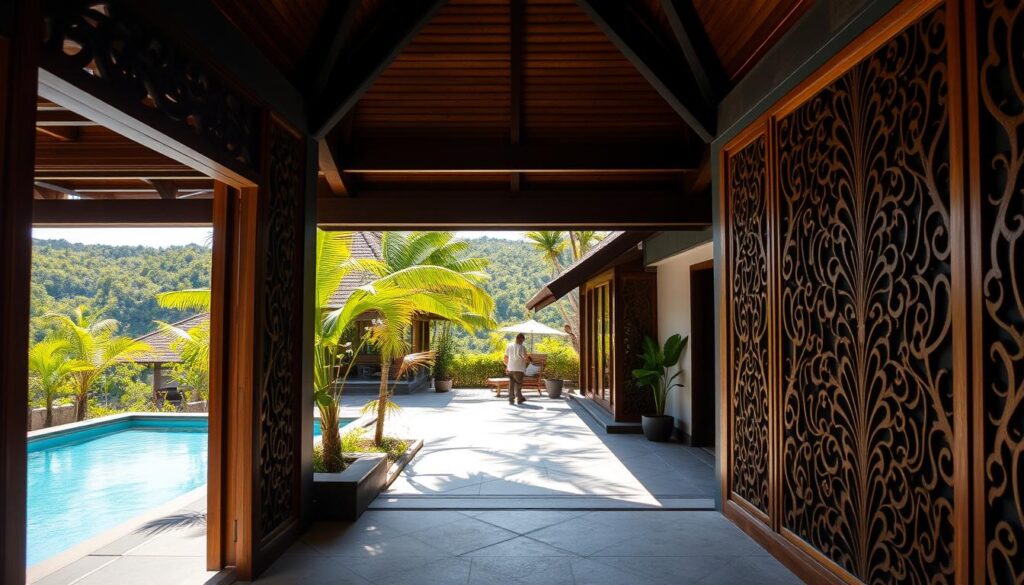
Modern-Balinese fusion mixes carved wood doors, local stone cladding, and tactile finishes with clean-lined millwork. That blend gives a sense of authenticity while keeping maintenance predictable.
Indoor-outdoor flow uses sliding glass walls, deep overhangs, breezeways, and covered terraces to extend living into shaded outdoors. Prioritize cross-ventilation and shading for thermal comfort in a tropical climate.
Compact typologies deliver higher ROI on small plots. Use lofted beds, built-in storage, and multipurpose furniture to maximize usable area without feeling cramped.
“Design intent must be documented to protect value and prevent poor value-engineering.”
- Durable local materials: teak, bamboo, lava stone with proper treatment.
- High-demand features: work nooks, resort-grade bedrooms, outdoor kitchens.
- Sustainable systems: rainwater capture, solar-ready roofs, low-VOC finishes.
Bali villa construction standards
Start every build by matching geotech data to structural design to avoid costly rework later.
Soil tests set pile depth and slab thickness: use 10 cm slabs over rock and 15 cm on unstable soils. Tie rebar mesh into sloof beams so slabs behave like rafts. Require certified geotechnical and structural engineers to size bore piles, beams, and columns.
Columns need adequate concrete cover (≥3 cm) and must not be drilled for plumbing. Thin, cosmetic columns are a liability. Enforce rebar sizing and proper pour sequencing to protect long-term strength.
For flat roofs, specify a proven waterproofing system such as a bitumen membrane with a long warranty; painted cement finishes will crack. MEP plans should include PLN-grade breaker boxes, grounding, RCDs, and clear service chases.
Use phased inspections: substructure, structure, MEP rough-in, waterproofing, and pre-close. Run ponding, insulation-resistance, and pressure tests. Log photos, test results, as-built drawings, and name product warranties for a transparent handover.
- Warranty: contractor labor 6–12 months; named product warranties for membranes and equipment.
Selecting Contractors, Bids, and Rock-Solid Contracts

Prioritize bids from teams with proven rainy-season durability and transparent BOQs. Solicit at least three competitive offers using a BOQ that lists quantities only. Require itemized pricing, exclusions, timeline, and warranty details so you can compare apples to apples.
Shortlist builders with 5+ years of experience and completed villa projects. Visit at least one delivered property that has stood through rainy seasons to inspect workmanship, waterproofing, and finishes.
Key contract and bid clauses
Execute a bilingual contract (Indonesian/English) with a materai stamp. Attach all drawings and initialed addendums and define the scope, brands, models, and technical specs to curb substitutions.
Lock payment milestones to BOQ groups: 10% down; 25% at ~30%; 25% at ~60%; 25% at ~90%; 10% at handover; 5% post-warranty. Tie each release to third-party or owner-rep approvals and documented acceptance criteria.
Payments, penalties, and governance
- Include liquidated damages for delays and defect rectification windows.
- Hold retention through the defects liability period and release on successful close.
- Define a clear change-order process with pricing basis, approvals, and BOQ updates.
“Vet references, visit sites, and insist on BOQ-driven bids to protect time, cost, and quality.”
Require site safety, waste management, and community etiquette clauses. Establish a weekly communication cadence with photo reports, schedule updates, and risk flags so the project stays transparent from groundworks to final handover.
How Long It Really Takes: Your 2025 Construction Timeline
A realistic timeline keeps budgets honest and expectations aligned across the project team. Start by mapping concept surveys (weeks) and design/engineering (1–3 months). Permit lead times vary, so plan PBG submission early and allow extra for AMDAL or UKL-UPL where needed.
Pre-construction essentials
Finalize drawings, confirm zoning, and lock utility strategy with PLN and well providers. PLN requires MCB and grounding for permanent power—factor that into the schedule.
Ground to weatherproof shell
Expect substructure and piling, then columns, beams, slabs, and roof. Reaching a weather-tight shell typically marks ~30%–60% completion and is crucial for interior works to proceed without weather delays.
Final phase to handover
Route MEP, install finishes, run waterproofing, pressure, and IR tests, then complete snag lists. SLF inspection follows final documentation and as-built O&M manuals.
- Build window: plan 8–14+ months depending on scope and season.
- Quality gates: waterproofing mockups and MEP tests before mass works.
- Governance: update schedule weekly and tie payments to inspected milestones.
“Buffer the rainy season with covered work zones and re-baseline when changes occur.”
The Construction Process Step by Step
Early coordination of access, utilities, and drainage sets up the project for faster progress. Start by building temporary access and confirming drainage lines so earthworks and deliveries run on schedule.
Site preparation typically includes fill trucks (IDR 800k–1M each), road grading (~IDR 1M/m), septic installation, well drilling if needed, and temporary power and worker housing. Install septic and reliable water first to avoid stoppages.
Site preparation
Manage fill, compaction, retaining walls, and drainage to prevent erosion into rice-field networks. Protect boundaries and plan access for piling rigs and concrete trucks.
Sub-structure
Execute bore piles, pile caps, and foundation walls per geotech findings. Raise finished floors above flood lines and use riverstone walls where required to hold fill.
Structure
Pour slabs to the specified thickness (10–15 cm) with tied rebar mesh and sloof beams. Erect columns and beams with correct concrete cover; do not route pipes through structural members.
Architectural works & finishes
Build walls (AAC or batako), fit windows and doors, and complete MEP rough-in before closing walls. Select roofing for your priorities: long-life membranes for waterproofing, or tiles and metal for specific acoustic or aesthetic needs.
Final scope: sequence tiling, joinery, sealants, and landscaping so external works finish last and protect interiors for guest readiness.
Material Choices That Perform in a Tropical Climate
Material decisions shape durability and guest comfort in tropical settings more than style alone. Specify assemblies that resist moisture, UV, and salt air while keeping maintenance predictable.
AAC blocks vs. batako masonry
AAC blocks offer better thermal resistance and faster installation. They cut heat transfer and reduce cooling loads.
Batako is cost-effective and widely available but heavier and less insulating. Both need proper detailing: moisture barriers, breathable plasters, and stainless fixings to avoid staining and corrosion.
Local stone, teak, and bamboo sourcing
Use kiln-dried, treated teak and responsibly harvested bamboo to limit swelling and pests. Local lava and riverstone work well for exteriors when paired with drip edges and drainage to preserve the site’s natural beauty.
Roofing choices and flat-roof membranes
For flat roofs, prefer certified bitumen membranes with documented warranties and vetted installers. Clay tiles look authentic but can dislodge in storms. Corrugated steel is durable but noisy; PVC sheets risk leaks at fasteners.
“Document brands and SKUs in the BOQ to prevent substitutions and maintain performance over time.”
- Specify stainless or hot-dip galvanized fasteners for coastal exposure.
- Standardize tile slip ratings and long-life sealants for wet areas and pools.
- List product SKUs and re-seal cycles in the BOQ for predictable upkeep.
Utilities and Infrastructure Planned Up Front
Locking in water, power, and drainage plans early saves time and prevents rework.
Start by confirming your water source: PDAM availability or a drilled well. Test for iron and hardness and size filtration or softening to protect fittings and guest comfort.
Water, wells, filtration, and septic sizing
Design septic systems to match expected occupancy and include grease traps for kitchens. Add service access and inspection ports for routine maintenance.
Plan well depth and filters based on lab results. Softening and iron removal extend appliance life and lower long-term maintenance.
Electricity, grounding, and reliable internet connectivity
Coordinate PLN timing and transformer needs early. Install a complete breaker box, grounding rod, MCBs, and RCDs before permanent hookup.
Provide temporary power via a generator to keep the site active during works. Trench ducts for fiber during civil works to avoid later rework.
Drainage design, road access, and waste management
Engineer swales, French drains, and subak tie-ins to move heavy rains off fill and protect retaining walls. Raise finished floors above local flood thresholds.
- Access: reinforce roads for heavy trucks and rainy-season deliveries.
- Process: document utility routes and mark critical lines in as-builts.
- Property: plan waste staging that fits operations and blends with landscaping.
Surge protection and lightning mitigation are necessary in tropical storms. Add labeled access boxes and signage so maintenance is fast and safe.
Interior and Exterior Features That Drive Value
Smart interior and exterior choices improve guest comfort and boost returns. Focus on daylight, ventilation, privacy, and finishes to protect the asset and reduce operating costs.
Daylight, ventilation, privacy, and resilient finishes
Optimize daylight with deep overhangs, clerestories, and reflective palettes to keep spaces cool and bright. Engineer cross‑ventilation through plan layout, louvered elements, and screened openings to lower AC usage.
Specify resilient finishes: porcelain tiles, marine‑grade hardware, and mildew‑resistant paints for longevity in humid air. Design privacy by using screens, planting layers, and orienting glazing away from neighbors without losing light.
Landscaping, outdoor lounges, pools, and view corridors
Layer landscapes with native species to cut maintenance and enhance curb appeal. Elevate outdoor living with shaded kitchens, lounges, and dining that extend usable area and lift ADR.
- Pool design: safe hydraulics, easy maintenance, and integrated outdoor showers.
- Protect view corridors with careful massing and tree placement.
- Standardize durable FF&E for fast turnovers and consistent guest experience.
Design for beauty and durability to make the property a marketable, low‑risk asset.
Risk Management in Bali’s Real-World Build Conditions
Rain, road limits, and neighbor relations shape real risk more than design alone. Plan logistics and sequencing so weather windows guide earthworks, piling, and major concrete pours.
Phase works to avoid peak rains. Use tents and curing shelters for critical pours and keep gravel stockpiles to stabilize muddy access.
Rainy-season sequencing and logistics
Build temporary roads and reinforced laydown areas. Protect stored materials and lock deliveries to reduce theft and damage.
Common quality pitfalls and audit checks
Audit structure before slabs: verify column sizes, rebar schedules, concrete cover, and compaction records. Reject thin columns and cosmetic waterproof paints.
- Pressure-test plumbing and pond roofs for leaks.
- Inspect grounding, breaker sizing, and RCDs with photos before closing walls.
- Keep daily QC walks, issue logs, and photo documentation to enforce the process.
Community relations and approvals
Engage banjar and village leaders early. Align working hours, traffic plans, and complaint contacts with local authorities.
“Good neighbor engagement speeds permits and reduces interruptions.”
Final note: insure the site, enforce safety protocols, and treat community feedback as part of the risk plan to keep the project on schedule and protect long-term value in the villa and building process.
Project Management, Reporting, and Change Control
A tight reporting rhythm and formal variation process are the backbone of successful site delivery. Keep records simple and current so teams act on facts, not guesses.
Site visits, inspections, and photo/video progress logs
Run weekly site walks from fixed vantage points and capture photo and video logs. Use the same angles each week so progress is obvious and verifiable.
Define inspection hold points that must be signed before the next work step. This prevents rework and protects the scope and budget.
Handling variations, BOQ updates, and timeline impacts
Route every change through a formal variation order that records cost, scope, and schedule effects. Update the BOQ and drawings as soon as a variation is approved.
Track earned value against agreed milestones to forecast cash needs and keep payment discipline. Tie releases to BOQ completion and inspected acceptance.
- Set a reporting cadence: weekly dashboards, photo logs, and a rolling four-week look-ahead.
- Maintain a live risk register to pre-empt material shortages and crew bottlenecks.
- Use area punchlists with owners, due dates, and photo verification for closure.
- Calibrate finish quality with mockups for bathrooms, joinery, and façades before mass rollout.
Escalate delays promptly and apply contractual remedies or recovery plans when needed. Keep one single source of truth for contracts, permits, test certificates, and as-builts so the handover runs smoothly.
“Documented steps, visible progress, and tight change control reduce disputes and speed final handover.”
At closeout, run multi-round snags, deep clean, and assemble O&M manuals and the SLF dossier. This final step ensures the property and the building are ready for operation and first guests.
From Handover to First Guests: Your Path to a Profitable Villa
Finish-line checks and guest-ready systems turn months of work into operating income.
Secure SLF immediately after commissioning so the property may list on OTAs and direct channels. Produce professional photos, clear floor plans, and amenity lists to speed bookings.
Stand up SOPs for housekeeping, maintenance, and guest comms. Choose management that wins direct bookings, not just OTA volume, and use dynamic pricing to lift RevPAR.
Track P&L monthly, include PBB and taxes, and engage local accountants for compliant filings and profit transfers. Schedule preventive maintenance and keep full documentation to protect resale value and the beauty of your home.
strong.