
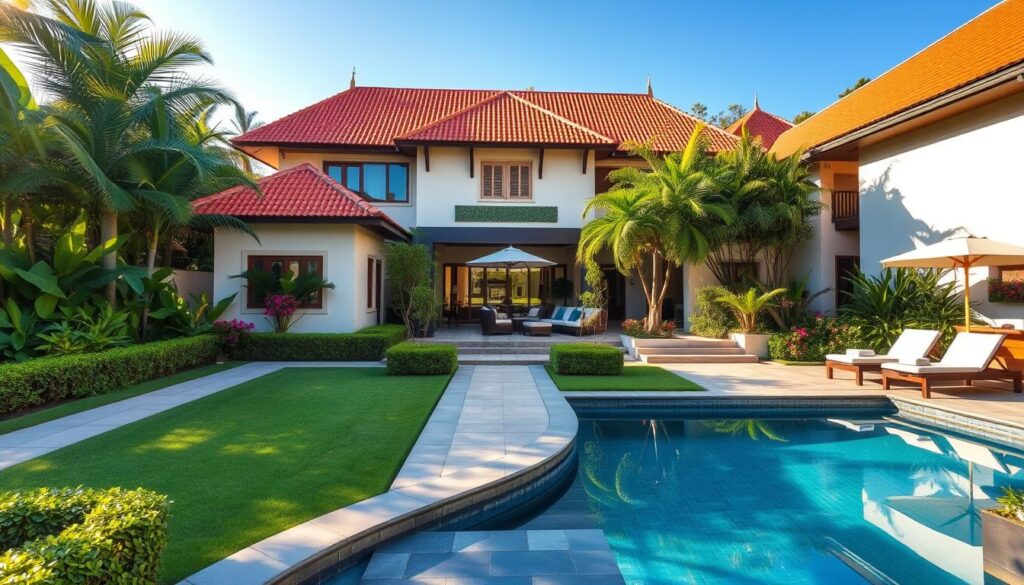
Surprising fact: average villa price jumped from $321,000 to about $484,000 from early 2024 to early 2025, reshaping choices for buyers and investors.
This guide sets clear expectations for 2025 by comparing sticker figures and true ownership costs. It shows why Canggu, Berawa, Pererenan pushed values higher while Tabanan stayed accessible.
Readers get a practical comparison of upfront sale figures versus total cost of ownership. Expect a breakdown of legal fees, taxes, permits, furnishing, and management charges that affect long-term value.
Quick preview: mid-market villas range widely, from roughly $200k up to $1M+ depending on bedrooms, land, and location. We’ll outline which property type fits lifestyle buyers and which suits rental investment goals.
Key Takeaways
- Bali’s villa price surge in the past year changes negotiation dynamics for buyers and investors.
- Total affordability covers taxes, notary fees, permits, furnishing, and management costs.
- Prime seaside locations command higher land and estate values than developing areas.
- Choose simpler houses for lifestyle aims, amenity-rich villas for rental yield potential.
- Use example listings and regional price anchors to set realistic expectations for 2025.
2025 snapshot: Bali real estate prices and what changed since 2024
The 2025 snapshot shows a rapid reset in local values, forcing buyers to rethink budgets and locations.
REID-based figures put the average villa price at roughly $321,000 in Q1 2024 and about $484,000 by Q1 2025. That jump reshapes expectations across every area and type of property.
From $321k to $484k: the average villa price jump in one year
Demand near lifestyle hubs pushed the surge. Canggu, Berawa, and Pererenan saw the largest increases due to beach access, dining, and tourist flow. Even Ubud and Tabanan recorded steady appreciation.
Hotspots leading the surge: Canggu, Berawa, Pererenan
- Price brackets by area: Seminyak/Canggu $300k–$1M+; Ubud $200k–$600k; Sanur/Nusa Dua $150k–$400k; Tabanan $100k–$300k.
- Closing costs: notary/legal 1–2.5%, BPHTB 5%, PPh 2.5%.
- Holding costs: IMB/PBG permits, furnishing, plus property management at 10–20% of rental income.
Hotspots offer higher nightly rates and occupancy for villas, while apartments and secondary areas provide lower entry points for long-stay tenants and conservative investors.
| Area | Typical range | Main advantage |
|---|---|---|
| Seminyak / Canggu | $300k–$1M+ | Tourism, nightlife, walkability |
| Ubud | $200k–$600k | Nature, higher mid-market demand |
| Tabanan | $100k–$300k | Lower entry price, larger land |
Review current listings and compare similar villa sale offers by bedrooms and size. That validation helps avoid overpaying in this fast-moving market and frames smart negotiation.
House vs villa in Bali: definitions, use cases, and who they suit
Deciding which property fits your plans depends on features, location, and intended returns. This section contrasts simpler dwellings with amenity-rich estates so readers can match type to goals.
Houses: simpler design, lower price per m², personal use
Typical houses favor straightforward architecture and fewer luxury touches. They cost less per square meter and suit buyers seeking daily comfort, privacy, and lower upkeep.
Villas: amenities, pools, higher nightly rates, rental appeal
Villas include private pools, expansive indoor-outdoor flow, and premium finishes. These features drive higher nightly rates and work well for short-stay rentals in tourist hubs.
- Bedrooms and layout: extra bedrooms increase rental capacity and appeal to family groups.
- Maintenance: pools and landscaping raise annual budgets compared with minimalist homes.
- Marketing: lifestyle messaging works best for houses; experience-driven campaigns sell villas.
| Aspect | Houses | Villas |
|---|---|---|
| Typical cost per m² | Lower | Higher (premium finishes) |
| Main use | Full-time living, long-stay | Short-stay rentals, high-yield listings |
| Maintenance | Modest | Higher (pool, garden) |
| Bedrooms impact | Adds comfort | Expands rental income |
Both property types can appreciate with better infrastructure and strong demand. Prioritize due diligence on build quality, airflow, and water management to protect value when buying property bali.
Ownership 101: freehold, leasehold, and PT PMA for foreigners
Understanding title options and permits reduces legal risk for international investors eyeing Indonesian real estate.
Indonesia’s freehold (Hak Milik) is generally reserved for citizens. Foreign buyers usually secure interests via leasehold (Hak Pakai) or by setting up a PT PMA to control an estate.
PT PMA gives more operational control and can support commercial rentals. It carries higher setup costs and ongoing compliance duties than a straightforward leasehold purchase.
- Permits: any building must have an IMB (now PBG). Short-term rentals typically need a Pondok Wisata license.
- Costs: notary/legal ~1–2.5% of the sale price; BPHTB 5%; PPh 2.5%. Plan for these when budgeting.
- Leases: extensions often range from IDR 500 million to IDR 1 billion, depending on areas and demand.
| Ownership | Pros | Cons |
|---|---|---|
| Freehold | Clear title, resale appeal | Mostly for citizens |
| Leasehold / PT PMA | Access for foreigners, rental control | Higher setup, compliance costs |
Do full due diligence on titles, zoning, and usage rights. Keep all approvals, plans, and licenses in a compliance file before operating rentals or listing properties for sale.
How much is a house in Bali in 2025?
For buyers watching budgets, peripheral districts still offer the most affordable residential options, even after last year’s market surge.
Entry-level in developing areas
Price anchor: simpler houses in remote districts such as Tabanan often start around $100,000. These properties provide larger plots for the money and lower per‑m² costs than villas.
Mid-range near beaches and expat hubs
Close to coastlines and expat neighborhoods, mid-market family homes command higher sale values despite similar build sizes. Location and walkability drive that premium.
- Key price drivers: location, plot size, build quality, permits, and upgrade potential.
- Total cost view: purchase price plus IDR-denominated closing fees, minor upgrades, and furnishing.
- Advice: map schools, healthcare, and commute distances before any offer and compare active sale listings by area.
| Type | Typical price | Note |
|---|---|---|
| Entry-level | $100k | Developing areas, larger land |
| Mid-range | $200k–$400k+ | Coastal/expat hubs, higher demand |
| Affordability edge | Lower m² than villas | Lower maintenance, better for personal use |
Villa prices by area: Canggu, Seminyak, Ubud, Sanur, Nusa Dua, Tabanan
Across the island, price ranges diverge sharply by location and villa size, shaping buyer choices for 2025.
Canggu / Seminyak
Price band: $300,000–$1,000,000+ for mid-sized villas. The villa canggu segment commands premiums for walk-to-beach access, cafés, and co-working hubs.
Ubud
Price band: $200,000–$600,000. These villas emphasize privacy, views, and wellness layouts that suit longer stays and retreat-style guests.
Sanur / Nusa Dua
Price band: $150,000–$400,000. Quieter coastal living and family-friendly amenities lower entry points versus west-coast hotspots.
Tabanan
Price band: $100,000–$300,000. Buyers gain larger land parcels and a rural vibe while remaining linked to island hubs.
- Bedrooms and size strongly affect final sale price; adding one bedroom can lift nightly rates and occupancy in prime spots.
- Luxury builds in Seminyak/Canggu often exceed $1M when finishes, views, or beach access are included.
- Location detail—alley access, distance to beach, and noise—can shift prices inside the same band.
- Factor IDR-denominated closing and setup costs when comparing neighborhoods for an apples-to-apples view.
| Area | Typical range | Main draw |
|---|---|---|
| Canggu / Seminyak | $300k–$1M+ | Beaches, nightlife, rental demand |
| Ubud | $200k–$600k | Nature, wellness stays |
| Sanur / Nusa Dua | $150k–$400k | Quiet coastline, family-friendly |
| Tabanan | $100k–$300k | More land, rural appeal |
Tip: review active villa sale listings and recent transactions to confirm asking prices match seasonal demand and nearby sales before making offers.
Real-world examples and listings to benchmark prices
Comparing live sale examples helps buyers spot fair value in fast-moving coastal markets.
Canggu value benchmark: a 2-bedroom, 95 m² oceanfront community villa c. $226,630. The unit sits in a serviced complex with a shared pool, parking, rain shower, yoga/BBQ areas, and tropical gardens.
This example shows how modest size and community amenities support both personal use and steady rental positioning.
Canggu example details
- Bedrooms: 2
- Size: 95 m²
- Features: shared pool, parking, yoga/BBQ, tropical garden
- Role: value entry for villa canggu segment and short-stay listings
Sanur oceanfront contrast
Sanur premium: a 2-bedroom oceanfront villa listed near $850,000 with private pool and terrace. Projected daily rental about $350 (~$102,200/year at high occupancy), showing beach access can justify higher purchase price.
Use these two sales to compare sale terms, features, and distance to beach when assessing listings. Consider upgrading to a 3-bedroom villa if you target groups and higher ADR in Canggu or Seminyak.
| Example | Price (approx.) | Key draw | Rental note |
|---|---|---|---|
| Canggu 2-bed, 95 m² | $226,630 | Serviced complex, shared amenities | Good occupancy, lower ADR |
| Sanur 2-bed oceanfront | $850,000 | Private pool, direct beach access | High ADR, strong income potential |
Takeaway: triangulate recent properties for sale by bedrooms, size, condition, and beach distance. Verify permits, HOA/service fees, and use local agents or valuers to validate price against workmanship and comparables.
Beyond the sticker price: taxes, legal, permits, and recurring costs
Sticker figures only tell part of the story; closing and running expenses shape real ownership economics.
Start by adding standard closing fees to any sale. Notary and legal charges typically run about 1–2.5% of the sale price. Expect BPHTB at 5% and PPh at 2.5% on transfers.
Permits and setup add IDR‑based line items. IMB/PBG permit costs commonly sit near IDR 30–50 million, though complexity and property type affect the final number.
Recurring operational costs shape cashflow. Property management often takes 10–20% of rental income. Utilities, pool and garden care, and routine maintenance rise for larger villas versus compact properties.
- Create a plan that includes furnishing and operational setup to speed time‑to‑market for rentals.
- Build a cash reserve in IDR for repairs, seasonal dips, and regulatory compliance.
- For leasehold buyers, plan for extensions; market and area desirability can push costs toward IDR 500 million–1 billion.
| Cost type | Typical range | Notes |
|---|---|---|
| Notary / legal | 1–2.5% of sale | Paid at closing |
| Taxes (BPHTB + PPh) | 5% + 2.5% | On transfer / sale |
| Permits (IMB/PBG) | IDR 30–50M | Depends on scope & area |
| Property management | 10–20% of income | Higher for villas with pools |
Model multiple occupancy scenarios before committing to any villa sale or residential purchase. Review sale documents carefully to confirm included fixtures, warranties, and developer obligations that could shift cost responsibilities after closing.
Land and apartment pricing: alternatives to buying a villa
Buyers seeking lower entry points often look at raw plots or apartment units as practical alternatives.
Land per m² bands
Prime plots near Seminyak, Uluwatu, and Canggu typically trade from $1,000 to $2,000 per m².
Developing areas such as Ubud, Seseh, and Pererenan commonly sit between $300 and $800 per m². Proximity to beaches and views drives the higher bands.
Apartments and lower entry options
Apartments offer faster occupancy and lower start costs. Prime-area monthly rents often range $700–$1,000. Quieter zones average near $500 per month.
They suit long-term tenants, digital nomads, and investors seeking steady yields without villa-level upkeep.
- Compare land price bands to decide if buying a plot then building beats a villa sale.
- Check zoning, utilities, and buildability before any land purchase; these factors affect the plan and timeline.
- Model returns: apartments yield differently than short-stay properties, so run realistic scenarios.
- Review recent sales and active listings by area to align offers with market reality.
| Option | Typical cost | Main advantage |
|---|---|---|
| Prime land (per m²) | $1,000–$2,000 | Near beaches, strong upside |
| Developing land (per m²) | $300–$800 | Lower entry, growth potential |
| Apartments (rent) | $500–$1,000/mo | Quick occupancy, low maintenance |
Investment lens: ROI drivers, rental demand, and area strategy
View investment decisions through yield, seasonality, and area momentum to see real returns over time.
Yield benchmarks: reported rental yields reach about 8–10% in Canggu and Ubud and can hit 15–20% in Seminyak. These bands reflect ADR, occupancy, and local demand patterns.
Ownership structure and returns
Leasehold often offers lower entry costs for foreigners and faster market access, but extensions (IDR 500M–1B) affect long-term returns. Freehold leasehold via PT PMA raises acquisition budgets yet can support stronger exit pricing for investors.
- Property selection: a well-equipped 3-bedroom villa lifts ADR and group demand compared with smaller units.
- Operating sensitivity: model management fees, maintenance, and utilities in IDR to avoid margin surprises.
- Multi-year view: plan for regulatory shifts, supply changes, and infrastructure that change market value over years.
| Metric | Canggu / Ubud | Seminyak |
|---|---|---|
| Typical yield | 8–10% | 15–20% |
| Main drivers | Consistent demand, longer stays | High ADR, group bookings |
| Cost sensitivity | Moderate (management 10–20%) | High (premium services needed) |
Action for investors: use data-driven pricing, frequent comp checks, and a local advisory team (agent, notary, tax pro, manager) to protect cash flow and capital gains for property bali.
Is a house or a villa more affordable in 2025? A side-by-side view
Putting sticker price next to annual outflows exposes which property type wins on true affordability this year.
Quick summary: houses usually offer lower price per square meter and simpler maintenance. Villas demand higher purchase prices because of pools, premium finishes, and stronger rental upside.
Upfront affordability: houses typically cost less to buy and hold. Villas in Seminyak/Canggu often sit between $300,000 and $1,000,000+, while Tabanan can range $100,000–$300,000.
Ongoing costs: villa pools, gardens, and service staff raise annual expenses versus properties of similar size and bedrooms. Yet premium villa sale locations can command ADR that offsets cost if occupancy holds.
- Use case: choose villas for rental returns; choose houses for lifestyle and lower upkeep.
- Bedrooms: extra bedrooms boost villa revenue potential more than for simple houses.
- Area matters: larger lots in Tabanan yield size per dollar; Seminyak/Canggu demands bigger budgets.
| Type | Typical price | Main trade-off |
|---|---|---|
| Houses | $100k–$400k | Lower buy/hold cost, less rental upside |
| Villas | $100k–$1M+ | Higher cost, stronger rental income potential |
| Decision | Depends on goal | Buy for cost or for cash flow |
Bottom line: houses tend to be more affordable to acquire and maintain. Villas can match or beat affordability over time if rental performance meets projections and area demand remains strong. Validate every sale with current comps before you commit.
Your next steps to find the right property in Bali
Create a focused acquisition roadmap that links preferred neighborhoods, financing limits, and return targets before you chase listings or viewings.
Define a short list of areas—Nusa Dua, Canggu, or developing suburbs—and set clear budget bands for any villa sale or sale offer. Build a comp library and set alerts on major portals to track price moves.
Engage a trusted real estate advisor, get an independent appraisal, and hire legal counsel early to review titles and leasehold terms. Plan IDR reserves for closing fees (notary 1–2.5%, BPHTB 5%, PPh 2.5%), lease extensions (IDR 500M–1B), and management (10–20% of income).
For investors: shortlist two or three properties, model total cost of ownership across villas, land, and apartments, then move decisively on offers backed by comps and solid due diligence.
FAQ
What changed in Bali real estate prices from 2024 to 2025?
Prices rose notably across popular zones. Average villa values jumped from roughly 1,000 to about 4,000, driven by stronger tourism, higher construction costs, and investor demand in areas such as Canggu, Berawa, and Pererenan.
Which areas led the price surge in 2025?
Canggu, Berawa, and Pererenan led due to lifestyle appeal, coworking and dining scenes, and short-term rental demand. These hotspots attracted both local and foreign buyers seeking rental yield and capital growth.
How do houses and villas differ for buyers and investors?
Houses generally offer simpler design, lower price per square meter, and suit owners focused on residential use. Villas include private pools and hospitality-style amenities, command higher nightly rates, and attract rental investors targeting vacation stays.
What ownership options exist for foreigners?
Foreign buyers typically use leasehold (Hak Pakai) or set up a PT PMA company for long-term operation. Freehold (Hak Milik) remains limited to Indonesian nationals. PT PMA can hold property and run rentals but requires legal setup and local compliance.
What permits and legal steps are essential for property use and rentals?
Key steps include obtaining IMB/PBG building permits and, for guest rentals, a Pondok Wisata permit where required. Notary work, sales contracts, and tax registrations must be completed to avoid legal issues and to operate short-term rentals.
What price ranges should buyers expect across Bali areas in 2025?
Typical ranges: Canggu/Seminyak mid-sized villas 0k–
FAQ
What changed in Bali real estate prices from 2024 to 2025?
Prices rose notably across popular zones. Average villa values jumped from roughly $321,000 to about $484,000, driven by stronger tourism, higher construction costs, and investor demand in areas such as Canggu, Berawa, and Pererenan.
Which areas led the price surge in 2025?
Canggu, Berawa, and Pererenan led due to lifestyle appeal, coworking and dining scenes, and short-term rental demand. These hotspots attracted both local and foreign buyers seeking rental yield and capital growth.
How do houses and villas differ for buyers and investors?
Houses generally offer simpler design, lower price per square meter, and suit owners focused on residential use. Villas include private pools and hospitality-style amenities, command higher nightly rates, and attract rental investors targeting vacation stays.
What ownership options exist for foreigners?
Foreign buyers typically use leasehold (Hak Pakai) or set up a PT PMA company for long-term operation. Freehold (Hak Milik) remains limited to Indonesian nationals. PT PMA can hold property and run rentals but requires legal setup and local compliance.
What permits and legal steps are essential for property use and rentals?
Key steps include obtaining IMB/PBG building permits and, for guest rentals, a Pondok Wisata permit where required. Notary work, sales contracts, and tax registrations must be completed to avoid legal issues and to operate short-term rentals.
What price ranges should buyers expect across Bali areas in 2025?
Typical ranges: Canggu/Seminyak mid-sized villas $300k–$1M+, Ubud $200k–$600k, Sanur/Nusa Dua $150k–$400k, and Tabanan $100k–$300k for larger land parcels and rural plots.
Are there real listings that illustrate current pricing?
Yes. Examples include Canggu two-bedroom villas around $226,630 for compact oceanfront community units, and higher-end Sanur oceanfront two-bed properties near $850,000 with strong income potential. Use listings to benchmark size, features, and land area.
What additional costs should buyers budget beyond the sale price?
Expect notary and legal fees (about 1–2.5% of sale), taxes like 5% BPHTB and 2.5% PPh on certain transactions, permit costs (IMB/PBG), furnishing, utility connections, and ongoing property management fees typically 10–20% of rental revenue.
How does land pricing compare to built villas?
Land in prime locations can run $1,000–$2,000 per m², while developing zones are $300–$800 per m². Buying land lets owners design custom villas, often offering better long-term value if planning permissions and access are in place.
Are apartments a viable alternative to villas for buyers?
Apartments provide lower entry costs and simpler maintenance, making them good for long-term stays or rental portfolios focused on expats and digital nomads. They typically require less land and lower setup complexity than standalone villas.
What rental yields can investors expect by area?
Typical yields vary: Canggu and Ubud often show 8–10% gross, while parts of Seminyak with high occupancy can reach 15–20% for well-managed properties during peak seasons. Actual returns depend on marketing, property quality, and management costs.
How do freehold and leasehold ownership affect investment returns?
Freehold provides clearer long-term security and resale value but is mostly restricted to Indonesians. Leasehold offers foreign access but can reduce resale appeal and requires careful negotiation of term length and renewal clauses, which influences yields and exit strategy.
What are the entry-level options for buyers on a budget?
Entry-level choices include houses or land in developing districts like Tabanan or outskirts around Denpasar, and smaller apartments. These options lower upfront cost and offer room for value growth as infrastructure and demand improve.
Which property type is more affordable in 2025: a house or a villa?
Generally, modest houses remain more affordable per square meter than full-service villas. However, villas can offer higher rental income that offsets the premium price. Affordability depends on location, land size, and intended use—personal residence versus investment.
What are practical next steps for buyers ready to search in Bali?
Start by defining budget, preferred areas, and ownership route (leasehold vs PT PMA). Use reputable agents, verify legal documents with a notary, and budget for taxes and permits. Visit shortlisted properties and model rental projections before committing.
M+, Ubud 0k–0k, Sanur/Nusa Dua 0k–0k, and Tabanan 0k–0k for larger land parcels and rural plots.
Are there real listings that illustrate current pricing?
Yes. Examples include Canggu two-bedroom villas around 6,630 for compact oceanfront community units, and higher-end Sanur oceanfront two-bed properties near 0,000 with strong income potential. Use listings to benchmark size, features, and land area.
What additional costs should buyers budget beyond the sale price?
Expect notary and legal fees (about 1–2.5% of sale), taxes like 5% BPHTB and 2.5% PPh on certain transactions, permit costs (IMB/PBG), furnishing, utility connections, and ongoing property management fees typically 10–20% of rental revenue.
How does land pricing compare to built villas?
Land in prime locations can run
FAQ
What changed in Bali real estate prices from 2024 to 2025?
Prices rose notably across popular zones. Average villa values jumped from roughly $321,000 to about $484,000, driven by stronger tourism, higher construction costs, and investor demand in areas such as Canggu, Berawa, and Pererenan.
Which areas led the price surge in 2025?
Canggu, Berawa, and Pererenan led due to lifestyle appeal, coworking and dining scenes, and short-term rental demand. These hotspots attracted both local and foreign buyers seeking rental yield and capital growth.
How do houses and villas differ for buyers and investors?
Houses generally offer simpler design, lower price per square meter, and suit owners focused on residential use. Villas include private pools and hospitality-style amenities, command higher nightly rates, and attract rental investors targeting vacation stays.
What ownership options exist for foreigners?
Foreign buyers typically use leasehold (Hak Pakai) or set up a PT PMA company for long-term operation. Freehold (Hak Milik) remains limited to Indonesian nationals. PT PMA can hold property and run rentals but requires legal setup and local compliance.
What permits and legal steps are essential for property use and rentals?
Key steps include obtaining IMB/PBG building permits and, for guest rentals, a Pondok Wisata permit where required. Notary work, sales contracts, and tax registrations must be completed to avoid legal issues and to operate short-term rentals.
What price ranges should buyers expect across Bali areas in 2025?
Typical ranges: Canggu/Seminyak mid-sized villas $300k–$1M+, Ubud $200k–$600k, Sanur/Nusa Dua $150k–$400k, and Tabanan $100k–$300k for larger land parcels and rural plots.
Are there real listings that illustrate current pricing?
Yes. Examples include Canggu two-bedroom villas around $226,630 for compact oceanfront community units, and higher-end Sanur oceanfront two-bed properties near $850,000 with strong income potential. Use listings to benchmark size, features, and land area.
What additional costs should buyers budget beyond the sale price?
Expect notary and legal fees (about 1–2.5% of sale), taxes like 5% BPHTB and 2.5% PPh on certain transactions, permit costs (IMB/PBG), furnishing, utility connections, and ongoing property management fees typically 10–20% of rental revenue.
How does land pricing compare to built villas?
Land in prime locations can run $1,000–$2,000 per m², while developing zones are $300–$800 per m². Buying land lets owners design custom villas, often offering better long-term value if planning permissions and access are in place.
Are apartments a viable alternative to villas for buyers?
Apartments provide lower entry costs and simpler maintenance, making them good for long-term stays or rental portfolios focused on expats and digital nomads. They typically require less land and lower setup complexity than standalone villas.
What rental yields can investors expect by area?
Typical yields vary: Canggu and Ubud often show 8–10% gross, while parts of Seminyak with high occupancy can reach 15–20% for well-managed properties during peak seasons. Actual returns depend on marketing, property quality, and management costs.
How do freehold and leasehold ownership affect investment returns?
Freehold provides clearer long-term security and resale value but is mostly restricted to Indonesians. Leasehold offers foreign access but can reduce resale appeal and requires careful negotiation of term length and renewal clauses, which influences yields and exit strategy.
What are the entry-level options for buyers on a budget?
Entry-level choices include houses or land in developing districts like Tabanan or outskirts around Denpasar, and smaller apartments. These options lower upfront cost and offer room for value growth as infrastructure and demand improve.
Which property type is more affordable in 2025: a house or a villa?
Generally, modest houses remain more affordable per square meter than full-service villas. However, villas can offer higher rental income that offsets the premium price. Affordability depends on location, land size, and intended use—personal residence versus investment.
What are practical next steps for buyers ready to search in Bali?
Start by defining budget, preferred areas, and ownership route (leasehold vs PT PMA). Use reputable agents, verify legal documents with a notary, and budget for taxes and permits. Visit shortlisted properties and model rental projections before committing.
,000–,000 per m², while developing zones are 0–0 per m². Buying land lets owners design custom villas, often offering better long-term value if planning permissions and access are in place.
Are apartments a viable alternative to villas for buyers?
Apartments provide lower entry costs and simpler maintenance, making them good for long-term stays or rental portfolios focused on expats and digital nomads. They typically require less land and lower setup complexity than standalone villas.
What rental yields can investors expect by area?
Typical yields vary: Canggu and Ubud often show 8–10% gross, while parts of Seminyak with high occupancy can reach 15–20% for well-managed properties during peak seasons. Actual returns depend on marketing, property quality, and management costs.
How do freehold and leasehold ownership affect investment returns?
Freehold provides clearer long-term security and resale value but is mostly restricted to Indonesians. Leasehold offers foreign access but can reduce resale appeal and requires careful negotiation of term length and renewal clauses, which influences yields and exit strategy.
What are the entry-level options for buyers on a budget?
Entry-level choices include houses or land in developing districts like Tabanan or outskirts around Denpasar, and smaller apartments. These options lower upfront cost and offer room for value growth as infrastructure and demand improve.
Which property type is more affordable in 2025: a house or a villa?
Generally, modest houses remain more affordable per square meter than full-service villas. However, villas can offer higher rental income that offsets the premium price. Affordability depends on location, land size, and intended use—personal residence versus investment.
What are practical next steps for buyers ready to search in Bali?
Start by defining budget, preferred areas, and ownership route (leasehold vs PT PMA). Use reputable agents, verify legal documents with a notary, and budget for taxes and permits. Visit shortlisted properties and model rental projections before committing.